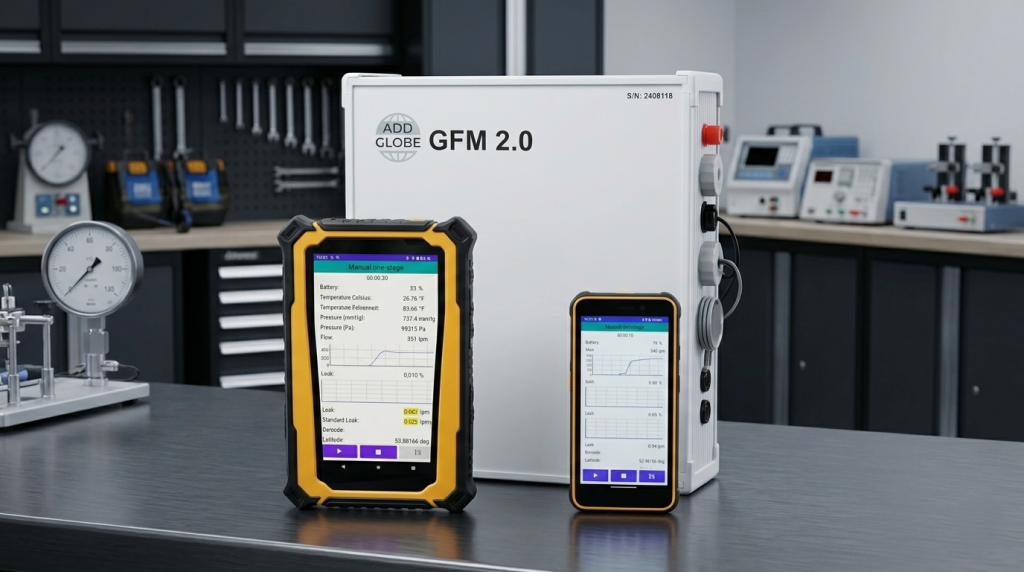
Today marks a major milestone in emissions monitoring technology with the launch of GFM 3.0 — our most advanced methane detection solution to date. Built from the ground up for precision, safety, and true field portability, GFM 3.0 sets a new benchmark for performance across the entire energy value chain.
Methane-Specific Laser Technology with Breakthrough Sensitivity
At the core of GFM 3.0 is a next‑generation, methane‑specific laser measurement system engineered to deliver detection limits as low as 0.5 g/h. This level of sensitivity empowers operators to identify and quantify even the smallest emission sources, supporting more accurate reporting, faster mitigation, and stronger environmental stewardship.
Whether deployed for routine inspections, compliance-driven surveys, or rapid-response leak investigations, GFM 3.0 provides the clarity and confidence needed to make informed decisions in the field.
Designed for ATEX Ex ia (Zone 0)
Safety is non‑negotiable in hazardous environments. GFM 3.0 is fully designed for ATEX Ex ia (Zone 0) operation, ensuring it can be used directly within explosive atmospheres without compromising performance or compliance. This intrinsic safety design allows teams to work efficiently and confidently in the most demanding conditions.
Portable, Explosion-Proof, and Built for the Entire Energy Sector
GFM 3.0 is engineered for real‑world use across:
- Upstream production sites
- Midstream pipelines and processing facilities
- Downstream distribution networks
- Storage and LNG infrastructure
Its rugged, explosion‑proof construction and lightweight, portable form factor make it ideal for field technicians, emissions specialists, and inspection teams who need reliable performance wherever the job takes them.
Raising the Standard for Emissions Monitoring
As global expectations for methane transparency and reduction continue to rise, GFM 3.0 delivers the precision, safety, and usability required to meet the moment. It’s more than an instrument — it’s a platform for better data, better decisions, and better environmental outcomes.